
I got to know Daniel Naroditsky about five years ago - not through his speedruns, but as a commentator. For me, he was part of the chess boom, that incredible moment when chess was finally getting the attention it deserved. He helped build what we now think of as "esports chess" - making tournaments not just competitive, but genuinely exciting to watch. And while he was doing that, he was also touching thousands of students' lives, helping them actually understand this beautiful game.
Daniel Naroditsky passed away last month, leaving the chess world in shock and sorrow. But instead of dwelling on the tragedy, let’s celebrate his contributions, and share what made his voice, his teaching, and his legacy so unforgettable.
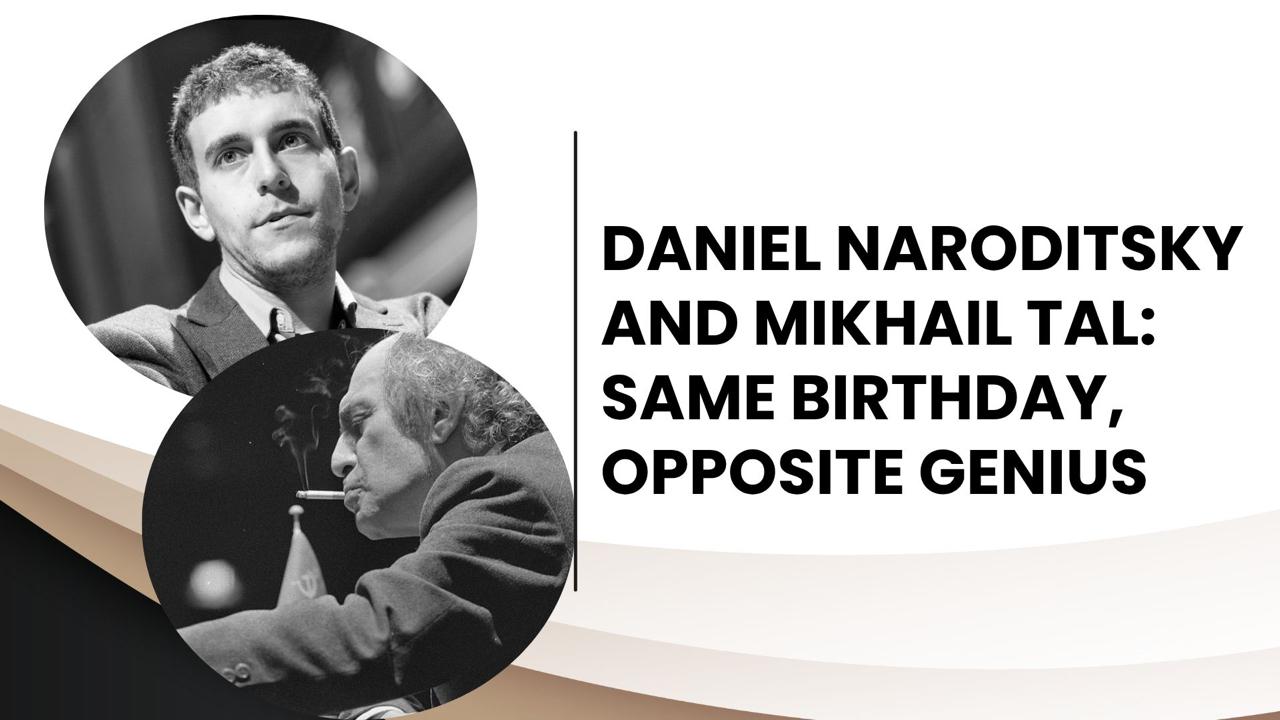
Daniel Naroditsky was born on November 9, 1995. Exactly 60 years earlier, Mikhail Tal was born on the same day in 1936.
Two chess players. Same birthday, but completely opposite approaches to the game.
Danya made chess understandable. Tal made chess magic.
And both? Both changed the game forever.
Danya's Revolution: Making Chess Make Sense
The Commentator Who Became a Teacher
Before the speedruns made him famous, before the 480,000 YouTube subscribers, Danya was doing something equally important: he was making chess watchable.
He became Chess.com's lead commentator in 2021, and was highly regarded for being insightful and entertaining, with an ability to make puns alongside deep analysis.
But here's what made him special as a commentator: he never talked down to you, he was humble, people's person. When a grandmaster made a move, Danya didn't just say "this is brilliant" - he explained why it was brilliant in a way that made you feel like you could understand it too.
That's the same energy he brought to teaching. Playing chess is one skill, however being a talented teacher as himself was something that many did not possess in the chess world.
The Method That Changed Everything
Danya's YouTube channel reached over 480,000 subscribers with over 93 million views, with his Speedrun series being his most popular educational content.
The concept was simple: start at a low rating and play your way up, explaining every thought process that went into every move.
But the execution? That's what made it revolutionary.
As one professor described it: "He would tell you 'This is the kind of mistake you're going to see at this level,' and he would make mistakes, too, and talk to you how to manage them".
He didn't just teach you his chess. He understood you, and taught you your-level chess, to find your own style and your own success.
Principles You Can Actually Use
We often hear the advice: "Don’t treat the symptom, treat the cause." But in practice, that’s easier said than done. When a symptom escalates, your instinct is to neutralize it immediately, even if the fix only works in the short term.
Danya made a crucial distinction on board too: in chess, you can either remove the symptom of a tactical threat, or remove its cause. Say your opponent is threatening a knight fork on e7, targeting your king and queen. You could place a rook on e8 to block it, that's treating the symptom. Or, you could move your king to safety, that's removing the cause. The first option may hold for a move or two. The second solves the problem entirely.
Plans Can Be Long (But Stay Flexible):
In one speedrun game, Danya's plan was to bring a knight from b1 to d5 via a3, c4, and c3 - that's four moves! But he didn't blindly execute it. The plan was a general goal while still reacting to what his opponent was doing.
This taught thousands of players: having a long-term vision doesn't mean being rigid.
Different Advice for Different Levels
Here's what separated Danya from other chess streamers by tailoring his suggestions based on the experience:
In games at the 700-1000 rating range, Danya focused on common mistakes and patterns specific to that level, emphasizing that players should always consider their opponent's potential replies before making moves.
Playing 1000-rated opponents? "Look for hanging pieces. Don't get fancy."
Playing 1800-rated opponents? "Now we think about pawn structure and long-term plans."
He met you exactly where you were, then showed you the next step up.
Why Danya's Method Worked So Well
He Thought Out Loud
This was the magic. Danya didn't just show you the best move. He showed you his entire decision-making process, one always finds complicated to put out there. Thinking, explaining and playing is not a simple multitasking, that is a very unique trait one would hope to have. He was portraying the process by explaning:
- What he was considering
- Why some moves looked tempting but were traps
- What his opponent might be planning
- How to adjust when things didn't go as expected
The contrast with other streamers was stark. As viewers noted: "Hikaru never explains his thoughts. Danya does. They're completely different content. One's entertaining, the other is informative".
He Made It About Understanding, Not Memorizing
In his comprehensive teaching method spanning 18 chapters, Danya would select favorite examples and guide viewers around common mistakes, revealing his approach for training in each area: openings, tactics, calculation, positional play, and endgames.
He didn't want you to memorize lines. He wanted you to understand chess.
And that's why his students actually improved. That's why thousands of people credit him with helping them break through their plateau.
Then There's Tal: The Opposite Approach
Now, let me tell you about the player born exactly 60 years before Danya.
Mikhail Tal became World Chess Champion at age 23 in 1960, playing in an attacking and daring combinatorial style known for improvisation and unpredictability (read more about Mikhail Tal).
Where Danya explained everything step-by-step, Tal just played. And what he played was pure chaos.
Tal would often sacrifice material without a specific variation calculated to the end, trusting his intuition for superior piece play and dynamic attacking possibilities.
Read that again: trusting his intuition.
Many masters found it difficult to refute Tal's ideas. Though deeper post-game analysis found flaws in some of his calculations, he often prevailed when unsettled opponents failed to find the correct response over the board. Maybe his talent was approaching chess differently, making the process a piece of art.
Tal's philosophy: "You must take your opponent into a deep dark forest where 2+2=5, and the path leading out is only wide enough for one."
That's not teaching. That's poetry. That's intimidation. That's chess as art.
Tal was feared not for extreme technical skill like Capablanca or Fischer, but because of the possibility of being on the wrong side of a soon-to-be-famous brilliancy.
Imagine sitting across from Tal. Your position looks good. You're up material, you get comfortable, let your guard down. But suddenly something's wrong. The clock is ticking. His pieces are swarming. And suddenly, your king is dead.
 The Bridge: What Danya Taught Us About Tal
Here's where these two opposite approaches connect.
Danya, the master teacher, often used historical games to illustrate principles. And Tal's games? They were perfect examples of what happens when you trust intuition beyond what the computer recommends.
Danya would sometimes analyze a Tal sacrifice and explain: "Objectively this might not be the best move according to the engine. But it creates practical problems your opponent can't solve over the board. That's worth more than being 'correct.'"
That's the most fascinating bridge between them.
Tal created beautiful chaos. Danya taught us to understand why that chaos worked.
How to Use Both Approaches
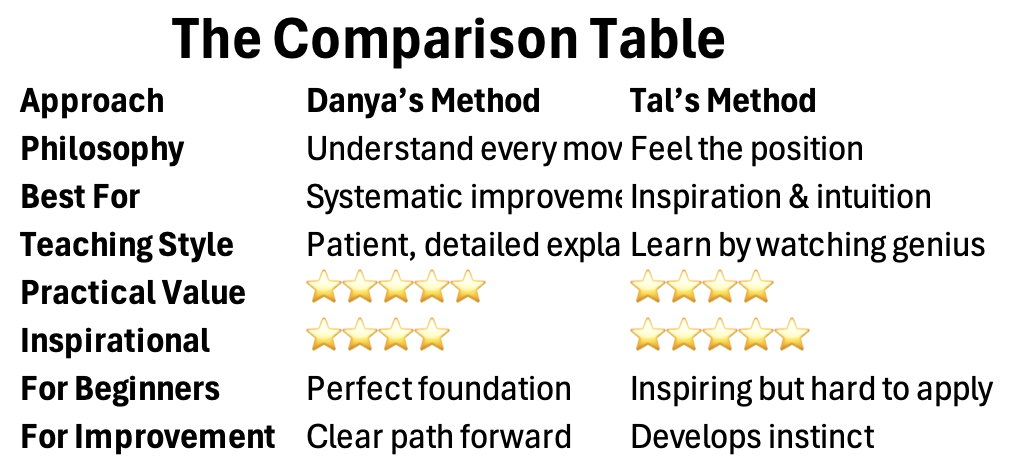
Here's what matters for your chess: you need both.
Start with Danya's Systematic Approach
At 800-1200 rating: Focus on:
- Not hanging pieces
- Basic tactical patterns (forks, pins, skewers)
- Simple plans (develop, castle, control center)
- Looking for your opponent's threats
At 1200-1600 rating: Add:
- Pawn structure awareness
- Piece coordination
- When to trade vs. keep pieces
- Creating and executing multi-move plans
At 1600-2000 rating: Master:
- Long-term positional planning
- Understanding when to sacrifice material
- Converting small advantages
- Exploiting opponent weaknesses
Use Danya's principles to build your chess foundation brick by brick.
Then Add Tal's Courage
But once you understand the principles, sometimes you need to break them.
Tal reminds us:
- The initiative can be worth more than material
- Complications favor the side who understands them better
- Psychology matters - your opponent has to defend perfectly
- Sometimes the "incorrect" move creates more practical winning chances
As chess writer Vladislav Zubok said of Tal: "Every game for him was as inimitable and invaluable as a poem".
Don't just play correctly. Play beautifully. Make your style memorable. Make it a masterpiece. Sometimes, the game you’ll remember most is the one where you challenged not just your opponent’s style, but your own. Enjoy every game you play.
More to explore: